BaseDog.it
Magic Site
main_900-15
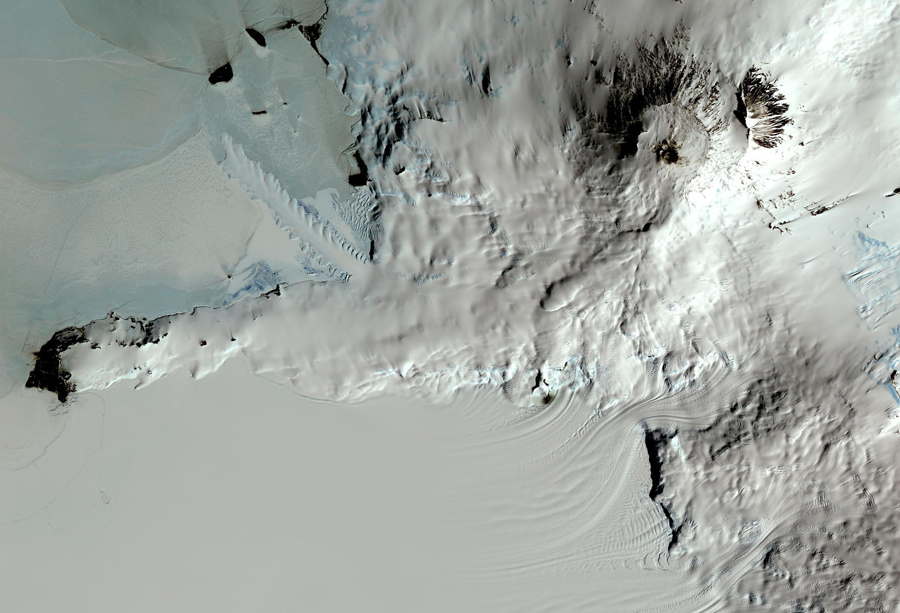
Seen by ASTER, an imaging instrument onboard Terra, one of NASA's Earth Observing System satellites, Mount Erebus, the world's southernmost historically active volcano, overlooks the McMurdo research station on Ross Island. The 3794-m-high Erebus is the largest of three major volcanoes forming the crudely triangular Ross Island. An elliptical 500 x 600 m wide, 110-m-deep crater truncates the summit and contains an active lava lake within a 250-m-wide, 100-m-deep inner crater. The glacier-covered volcano was erupting when first sighted by Captain James Ross in 1841. Continuous lava-lake activity with minor explosions, punctuated by occasional larger strombolian explosions that eject bombs onto the crater rim, has been documented since 1972, but has probably been occurring for much of the volcano's recent history. Image taken on December 31, 2013, released on January 15, 2016. (NASA / GSFC / METI / ERSDAC / JAROS, and U.S./Japan ASTER Science Team)