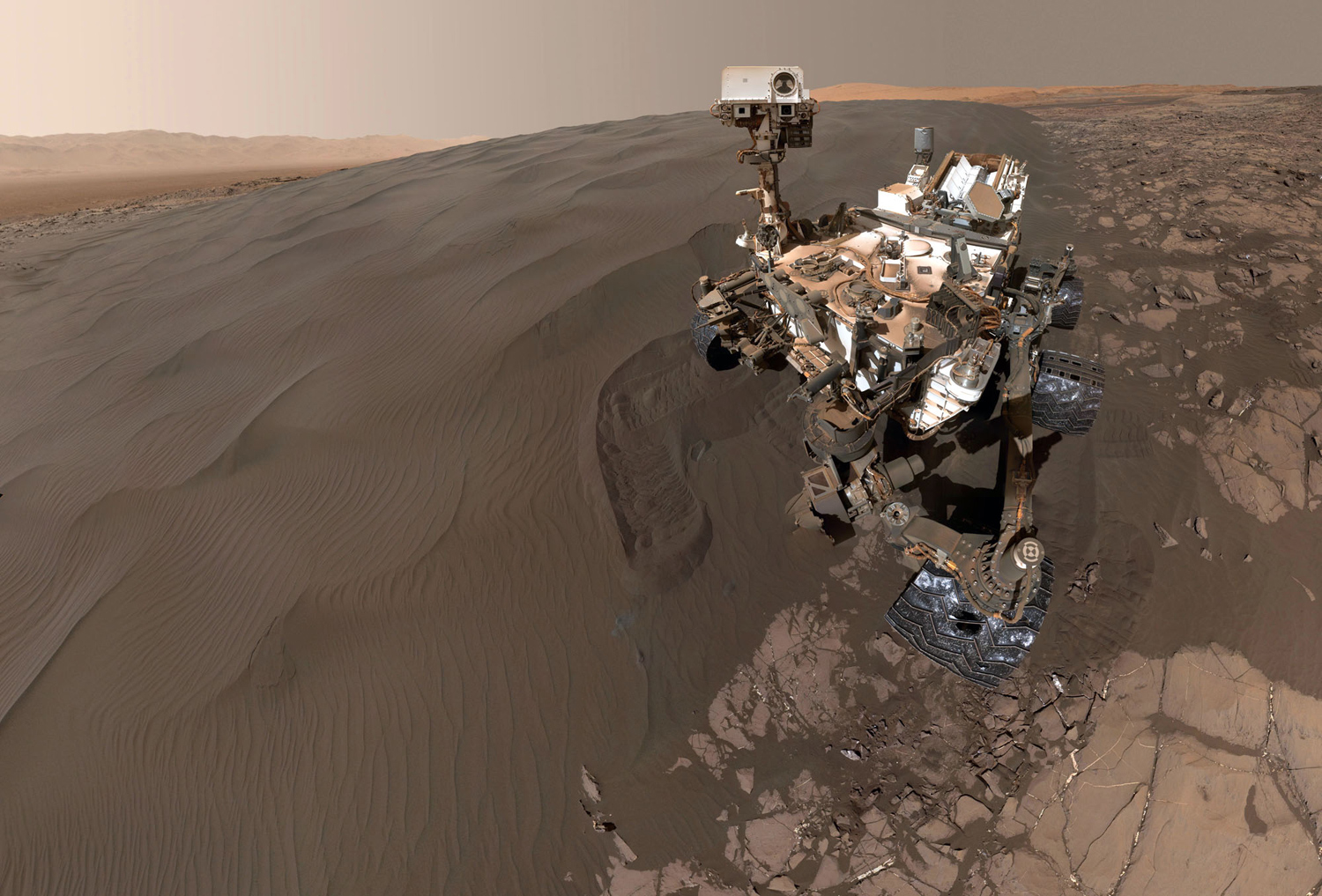
1# This self-portrait of NASA’s Curiosity Mars rover shows the vehicle at “Namib Dune,” where the rover’s activities included scuffing into the dune with a wheel and scooping samples of sand for laboratory analysis. The scene combines 57 images taken on January 19, 2016, during the 1,228th Martian day, or sol, of Curiosity’s work on Mars. The camera used for this is the Mars Hand Lens Imager (MAHLI) at the end of the rover’s robotic arm. Namib Dune is part of the dark-sand “Bagnold Dune Field” along the northwestern flank of Mount Sharp. Images taken from orbit have shown that dunes in the Bagnold field move as much as about 3 feet (1 meter) per Earth year.
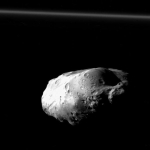
NASA’s Cassini spacecraft spied details on the pockmarked surface of Saturn’s moon Prometheus (86 kilometers, or 53 miles across) during a moderately close flyby on Dec. 6, 2015. This is one of Cassini’s highest resolution views of Prometheus. (NASA / JPL-Caltech / Space Science Institute)
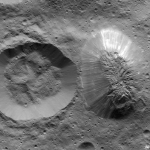
Ceres’ mysterious mountain Ahuna Mons is seen in this mosaic of images from NASA’s Dawn spacecraft. Dawn took these images from its low-altitude mapping orbit, 240 miles (385 kilometers) above the surface, in December 2015. The resolution of the component images is 120 feet (35 meters) per pixel. On its steepest side, this mountain is about 3 miles (5 kilometers) high. Its average overall height is 2.5 miles (4 kilometers). These figures are slightly lower than what scientists estimated from Dawn’s higher orbits because researchers now have a better sense of Ceres’ topography. The diameter of the mountain is about 12 miles (20 kilometers). Researchers are exploring the processes that could have led to this feature’s formation. (NASA / JPL-Caltech / UCLA / MPS / DLR / IDA / PSI)
The bright central spots near the center of Occator Crater are shown in enhanced color in this view from NASA’s Dawn spacecraft. Such views can be used to highlight subtle color differences on Ceres’ surface. (NASA / JPL-Caltech / UCLA / MPS / DLR / IDA / PSI / LPI)
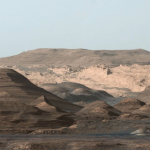
This composite image looking toward the higher regions of Mount Sharp was taken on September 9, 2015, by NASA’s Curiosity rover. In the foreground — about 2 miles (3 kilometers) from the rover — is a long ridge teeming with hematite, an iron oxide. Just beyond is an undulating plain rich in clay minerals. And just beyond that are a multitude of rounded buttes, all high in sulfate minerals. The changing mineralogy in these layers of Mount Sharp suggests a changing environment in early Mars, though all involve exposure to water billions of years ago. (NASA / JPL-Caltech / MSSS)
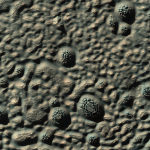
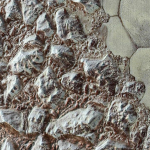
The Mars Hand Lens Imager (MAHLI) camera on the robotic arm of NASA’s Curiosity Mars rover used electric lights at night to illuminate this view of Martian sand grains dumped on the ground after sorting with a sieve. The view covers an area roughly 1.1 inches by 0.8 inch (2.8 centimeters by 2.1 centimeters). The grains seen here were too large to pass through a sieve with 150-micron (0.006 inch) pores. They were part of the sand in the first scoop collected by Curiosity at “Namib Dune.” A different portion of that scoop — consisting of grains small enough to pass through the 150-micron sieve — was delivered to the rover’s on-board laboratory instruments for analysis. The larger-grain portion dumped onto the ground became accessible to investigation by other instruments on Curiosity, including imaging by MAHLI and composition analysis by the Chemistry and Camera (ChemCam) and Alpha Particle X-ray Spectrometer instruments. Laser-zapping of the dump pile by ChemCam caused an elongated dimple visible near the center of this view. The MAHLI images combined into this focus-merged view were taken on Jan. 22, 2016, after dark on the 1,230th Martian day, or sol, of Curiosity’s work on Mars. The illumination source is two white-light LEDs (light-emitting diodes) on MAHLI. (NASA / JPL-Caltech / MSSS)
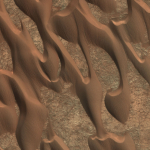
On Mars, dunes of Nili Patera, imaged by the HiRISE instrument aboard NASA’s Mars Reconnaissance Orbiter, December 31, 2015. ( NASA/JPL/University of Arizona)
On Mars, the eastern edge of a very large deposit of wind-blown dust that occupies Ganges Chasma, imaged by the HiRISE instrument aboard NASA’s Mars Reconnaissance Orbiter, March 10, 2016. ( NASA/JPL/University of Arizona)
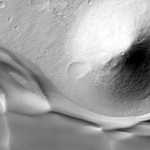
On Mars, dark butte capping material in a mid-latitude crater floor , imaged by the HiRISE instrument aboard NASA’s Mars Reconnaissance Orbiter, on December 25, 2015. ( NASA/JPL/University of Arizona)
Delicate features on Mars, sol 1283 11:18:00 A.M. LMST taken: 2016 MAR 16 (NASA)
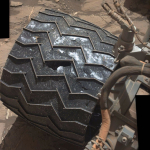
MSL wheel imaging, sol 1179 12:10:59 P.M. LMST taken: 2015 NOV 30 12:14:37 UTC. (NASA)
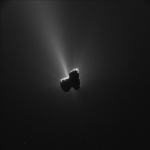
Single frame enhanced NavCam image taken on 28 January 2016, when Rosetta was 67.6 km from the nucleus of Comet 67P/Churyumov-Gerasimenko. (ESA / Rosetta / NavCam)
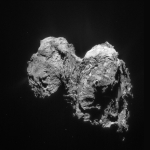
This single frame Rosetta navigation camera image of Comet 67P/Churyumov-Gerasimenko was taken on September 11, 2015 from a distance of 319 km from the comet center. The image has a resolution of 27.2 m/pixel and measures 27.9 km across. (ESA / Rosetta / NavCam)
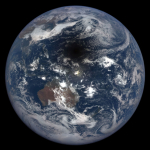
NASA’s EPIC camera, aboard NOAA’s DSCOVR satellite, captured a unique view of a solar eclipse on March 9, 2016. While residents of the Western Pacific looked up in the early morning hours to observe a total eclipse of the sun, DSCOVR looked on from a million miles away and captured the shadow of the moon crossing the planet. This series of images was captured by NASA’s Earth Polychromatic Imaging Camera (EPIC), a four megapixel CCD camera and telescope on the DSCOVR satellite. A million miles away, NOAA’s DSCOVR satellite is the Nation’s first operational satellite in deep space. DSCOVR hovers between the sun and Earth at all times, maintaining a constant view of the sun and sun-lit side of Earth. (NOAA / NASA)
Off North America’s East Coast. 2016.03.27 (NASA)
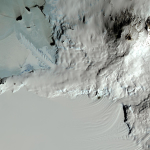
Seen by ASTER, an imaging instrument onboard Terra, one of NASA’s Earth Observing System satellites, Mount Erebus, the world’s southernmost historically active volcano, overlooks the McMurdo research station on Ross Island. The 3794-m-high Erebus is the largest of three major volcanoes forming the crudely triangular Ross Island. An elliptical 500 x 600 m wide, 110-m-deep crater truncates the summit and contains an active lava lake within a 250-m-wide, 100-m-deep inner crater. The glacier-covered volcano was erupting when first sighted by Captain James Ross in 1841. Continuous lava-lake activity with minor explosions, punctuated by occasional larger strombolian explosions that eject bombs onto the crater rim, has been documented since 1972, but has probably been occurring for much of the volcano’s recent history. Image taken on December 31, 2013, released on January 15, 2016. (NASA / GSFC / METI / ERSDAC / JAROS, and U.S./Japan ASTER Science Team)
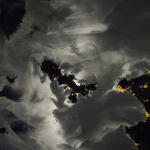
A crew member aboard the International Space Station took this photograph of the northern Mediterranean Sea and some coastal Italian towns and islands. The reflection of the Moon on the sea surface—moonglint—reveals highly complex patterns. The strongest reflection is near the center of the Moon’s disc, which brightens the water around the island of Elba. In these complex patterns, the dark areas of the sea surface can sometimes make islands (such as Montecristo and Pianosa) harder to see. (A similar phenomenon happens in the daylight, as shown in sunglint images of lakes in Brazil and aquaculture in the Nile Delta.) The reflection off sea surfaces captures many different natural processes, but also some made by humans. North of Elba, waves trailing behind ships make the classic V-shaped pattern. The meandering line coming off Montecristo Island is an “island wake,” a result of alternating vortices of wind that develop on the downwind side of the island. This wake is the strongest evidence that a northeast wind was blowing (right to left in this image) on the night of the photo. A shorter, meandering wind pattern is being shed off Punta Ala on the mainland. Smoother surfaces, protected from wind, are usually brighter because they are better mirror for moonlight. (NASA Earth Observatory)
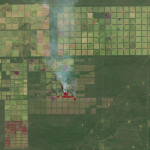
The chaco forests of northern Argentina spread across a vast outwash plain in the center of South America. Shrubs and hardwood forests thrive in the semi-arid region. For many years, puestos—small settlements centered around water sources—dotted the landscape. But in the past decade, large-scale farm and ranch operators have cleared broad swaths of the chaco to make way for livestock and crops raised on an industrial scale. In fact, an analysis of data collected by several Landsat satellites suggests that Argentina’s chaco faces one of the fastest tropical deforestation rates in the world. On October 15, 2015, the Operational Land Imager (OLI) on Landsat 8 captured this false-color image of fields, forests, and puestos in the Salta province of northern Argentina. The fields, most of which appear to be fenced, are arranged in a grid pattern. Fires are actively burning in a few sectors of the grid, likely lit by land managers trying to clear shrubs and trees to make room for livestock, timber, or crops. Fresh burn scars are dark brown; older burn scars are lighter brown. Over time, burned areas become light green and eventually dark green. (NASA Earth Observatory, Joshua Stevens, using Landsat data from the USGS)
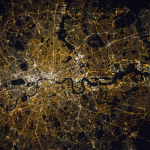
Much of London and its suburbs are visible in this photograph taken from the International Space Station on on September 27, 2015. Two of the characteristics that stand out at night are the progressively denser concentrations of lights and the change from yellower to whiter lights as you move towards the commercial center of the city. (NASA Earth Observatory)
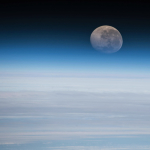
The Moon seen from orbit aboard the ISS om March 25, 2016, above New Zealand. (NASA)
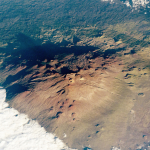
Mauna Kea (“White Mountain”) is the only volcano on the island of Hawaii that has evidence of glaciation. This photograph of Mauna Kea was taken by an astronaut as the International Space Station (ISS) passed over at approximately 5 p.m. local time on November 1, 2015. The late-afternoon lighting and oblique viewing angle accentuates the shadows, highlighting the white domes of the observatories along the crater rims. The angle also accentuates the numerous cinder cones and lava flows. (NASA)
The Sun, imaged by Atmospheric Imaging Assembly aboard NASA’s Solar Dynamics Observatory, on November 12, 2015. (NASA / SDO)
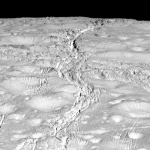
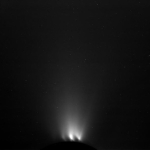
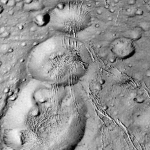
NASA’s Cassini spacecraft zoomed by Saturn’s icy moon Enceladus on Oct. 14, 2015, capturing this stunning image of the moon’s north pole. A companion view from the wide-angle camera (PIA20010) shows a zoomed out view of the same region for context. Scientists expected the north polar region of Enceladus to be heavily cratered, based on low-resolution images from the Voyager mission, but high-resolution Cassini images show a landscape of stark contrasts. Thin cracks cross over the pole — the northernmost extent of a global system of such fractures. Before this Cassini flyby, scientists did not know if the fractures extended so far north on Enceladus. North on Enceladus is up. The image was taken in visible green light with the Cassini spacecraft narrow-angle camera. The view was acquired at a distance of approximately 4,000 miles (6,000 kilometers) from Enceladus and at a Sun-Enceladus-spacecraft, or phase, angle of 9 degrees. Image scale is 115 feet (35 meters) per pixel. (NASA / JPL-Caltech / Space Science Institute)
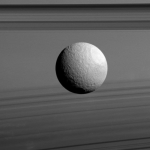
Saturn’s moon Tethys appears to float between two sets of rings in this view from NASA’s Cassini spacecraft, but it’s just a trick of geometry. The rings, which are seen nearly edge-on, are the dark bands above Tethys, while their curving shadows paint the planet at the bottom of the image. Tethys (660 miles or 1,062 kilometers across) has a surface composed mostly of water ice, much like Saturn’s rings. Water ice dominates the icy surfaces in the the far reaches of our solar system, but ammonia and methane ices also can be found. November 23, 2015. (NASA / JPL-Caltech / Space Science Institute)
Enceladus October 28, 2015 and received on Earth October 30, 2015. (NASA / JPL-Caltech / Space Science Institute)
NASA’s Cassini spacecraft paused during its final close flyby of Enceladus to focus on the icy moon’s craggy, dimly lit limb, with the planet Saturn beyond. Layers can be seen in the high hazes of Saturn’s upper atmosphere, in the gradient that separates the planet from space. December 19, 2015. (NASA / JPL-Caltech / Space Science Institute)
October 14, 2015 and received on Earth October 15, 2015. The camera was pointing toward Enceladus. (NASA / JPL-Caltech / Space Science Institute)
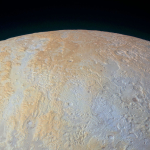
An enhanced color image of Pluto’s north polar area. Long canyons run vertically across the polar area — part of the informally named Lowell Regio, named for Percival Lowell, who founded Lowell Observatory and initiated the search that led to Pluto’s discovery. The widest of the canyons is about 45 miles (75 kilometers) wide and runs close to the north pole. Roughly parallel subsidiary canyons to the east and west are approximately 6 miles (10 kilometers) wide. The degraded walls of these canyons appear to be much older than the more sharply defined canyon systems elsewhere on Pluto, perhaps because the polar canyons are older and made of weaker material. These canyons also appear to represent evidence for an ancient period of tectonics. A shallow, winding valley runs the entire length of the canyon floor. To the east of these canyons, another valley winds toward the bottom-right corner of the image. The nearby terrain, at bottom right, appears to have been blanketed by material that obscures small-scale topographic features, creating a ‘softened’ appearance for the landscape. Large, irregularly-shaped pits reach 45 miles (70 kilometers) across and 2.5 miles (4 kilometers) deep, scarring the region. These pits may indicate locations where subsurface ice has melted or sublimated from below, causing the ground to collapse. (NASA / Johns Hopkins University Applied Physics Laboratory / Southwest Research Institute)
This enhanced color mosaic combines some of the sharpest views of Pluto that NASA’s New Horizons spacecraft obtained during its July 14 flyby. The pictures are part of a sequence taken near New Horizons’ closest approach to Pluto, with resolutions of about 250-280 feet (77-85 meters) per pixel — revealing features smaller than half a city block on Pluto’s surface. Lower resolution color data (at about 2,066 feet, or 630 meters, per pixel) were added to create this new image. The images form a strip 50 miles (80 kilometers) wide, trending (top to bottom) from the edge of “badlands” northwest of the informally named Sputnik Planum, across the al-Idrisi mountains, onto the shoreline of Pluto’s “heart” feature, and just into its icy plains. They combine pictures from the telescopic Long Range Reconnaissance Imager (LORRI) taken approximately 15 minutes before New Horizons’ closest approach to Pluto, with — from a range of only 10,000 miles (17,000 kilometers) — with color data (in near-infrared, red and blue) gathered by the Ralph/Multispectral Visible Imaging Camera (MVIC) 25 minutes before the LORRI pictures. (NASA / Johns Hopkins University Applied Physics Laboratory / Southwest Research Institute)
In September, the New Horizons team released a stunning but incomplete image of Pluto’s crescent. Thanks to new processing work by the science team, New Horizons is releasing the entire, breathtaking image of Pluto. This image was made just 15 minutes after New Horizons’ closest approach to Pluto on July 14, 2015, as the spacecraft looked back at Pluto toward the sun. The wide-angle perspective of this view shows the deep haze layers of Pluto’s atmosphere extending all the way around Pluto, revealing the silhouetted profiles of rugged plateaus on the night (left) side. The shadow of Pluto cast on its atmospheric hazes can also be seen at the uppermost part of the disk. On the sunlit side of Pluto (right), the smooth expanse of the informally named icy plain Sputnik Planum is flanked to the west (above, in this orientation) by rugged mountains up to 11,000 feet (3,500 meters) high, including the informally named Norgay Montes in the foreground and Hillary Montes on the skyline. Below (east) of Sputnik, rougher terrain is cut by apparent glaciers. The backlighting highlights more than a dozen high-altitude layers of haze in Pluto’s tenuous atmosphere. The horizontal streaks in the sky beyond Pluto are stars, smeared out by the motion of the camera as it tracked Pluto. The image was taken with New Horizons’ Multi-spectral Visible Imaging Camera (MVIC) from a distance of 11,000 miles (18,000 kilometers) to Pluto. The resolution is 700 meters (0.4 miles). (NASA / Johns Hopkins University Applied Physics Laboratory / Southwest Research Institute)
In September, the New Horizons team released a stunning but incomplete image of Pluto’s crescent. Thanks to new processing work by the science team, New Horizons is releasing the entire, breathtaking image of Pluto. This image was made just 15 minutes after New Horizons’ closest approach to Pluto on July 14, 2015, as the spacecraft looked back at Pluto toward the sun. The wide-angle perspective of this view shows the deep haze layers of Pluto’s atmosphere extending all the way around Pluto, revealing the silhouetted profiles of rugged plateaus on the night (left) side. The shadow of Pluto cast on its atmospheric hazes can also be seen at the uppermost part of the disk. On the sunlit side of Pluto (right), the smooth expanse of the informally named icy plain Sputnik Planum is flanked to the west (above, in this orientation) by rugged mountains up to 11,000 feet (3,500 meters) high, including the informally named Norgay Montes in the foreground and Hillary Montes on the skyline. Below (east) of Sputnik, rougher terrain is cut by apparent glaciers. The backlighting highlights more than a dozen high-altitude layers of haze in Pluto’s tenuous atmosphere. The horizontal streaks in the sky beyond Pluto are stars, smeared out by the motion of the camera as it tracked Pluto. The image was taken with New Horizons’ Multi-spectral Visible Imaging Camera (MVIC) from a distance of 11,000 miles (18,000 kilometers) to Pluto. The resolution is 700 meters (0.4 miles). (NASA / Johns Hopkins University Applied Physics Laboratory / Southwest Research Institute)
Saturn on March 22, 2016 and received on Earth March 24, 2016. (NASA / JPL-Caltech / Space Science Institute)