BaseDog.it
Magic Site
main_900-5
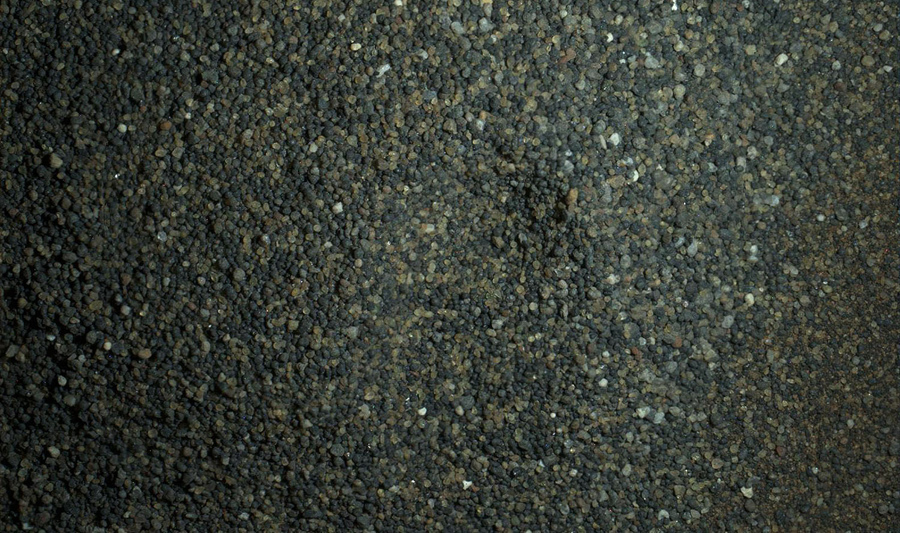
The Mars Hand Lens Imager (MAHLI) camera on the robotic arm of NASA's Curiosity Mars rover used electric lights at night to illuminate this view of Martian sand grains dumped on the ground after sorting with a sieve. The view covers an area roughly 1.1 inches by 0.8 inch (2.8 centimeters by 2.1 centimeters). The grains seen here were too large to pass through a sieve with 150-micron (0.006 inch) pores. They were part of the sand in the first scoop collected by Curiosity at "Namib Dune." A different portion of that scoop -- consisting of grains small enough to pass through the 150-micron sieve -- was delivered to the rover's on-board laboratory instruments for analysis. The larger-grain portion dumped onto the ground became accessible to investigation by other instruments on Curiosity, including imaging by MAHLI and composition analysis by the Chemistry and Camera (ChemCam) and Alpha Particle X-ray Spectrometer instruments. Laser-zapping of the dump pile by ChemCam caused an elongated dimple visible near the center of this view. The MAHLI images combined into this focus-merged view were taken on Jan. 22, 2016, after dark on the 1,230th Martian day, or sol, of Curiosity's work on Mars. The illumination source is two white-light LEDs (light-emitting diodes) on MAHLI. (NASA / JPL-Caltech / MSSS)